


RESI-MERCIAL!
Let’s talk about something that seems to really get under the skin of commercial agents… the “resi-mercial” agent.
You know, the person out there selling houses while also chasing commercial deals.
Most commercial brokers have the same opinion about them:
“They should just send all the commercial business to us.”
Now to be fair, commercial and residential are different skill sets. Different deal structures. Different language. That’s all true.
But we also now live in a world where you can order groceries, doom scroll social media, and remote start your car on the same device you use to sign contracts and make business phone calls.
Life is about integrated experiences now.
I left the big flag shop world after 19 years and hung my license with a residential company for about a year that was owned by a friend of mine.
It was a great place to land while I figured out what was next.
Honestly, I was shocked by what I found.
Turns out, I had been completely off base in how I viewed those “resi-mercial” folks.
The first thing I realized?
Great residential agents were taking home more money than I was. Not by a little. By a few hundred thousand dollars a year.
Meanwhile, me and the commercial boys were sitting around joking about the “resi-mercial” agent calling us asking for an OM on a commercial deal… while half the time we wouldn’t even return their calls.
Arrogant? Absolutely.
Ignorant? Yep.
Learning opportunity? Without question.
Then I started looking at the actual math.
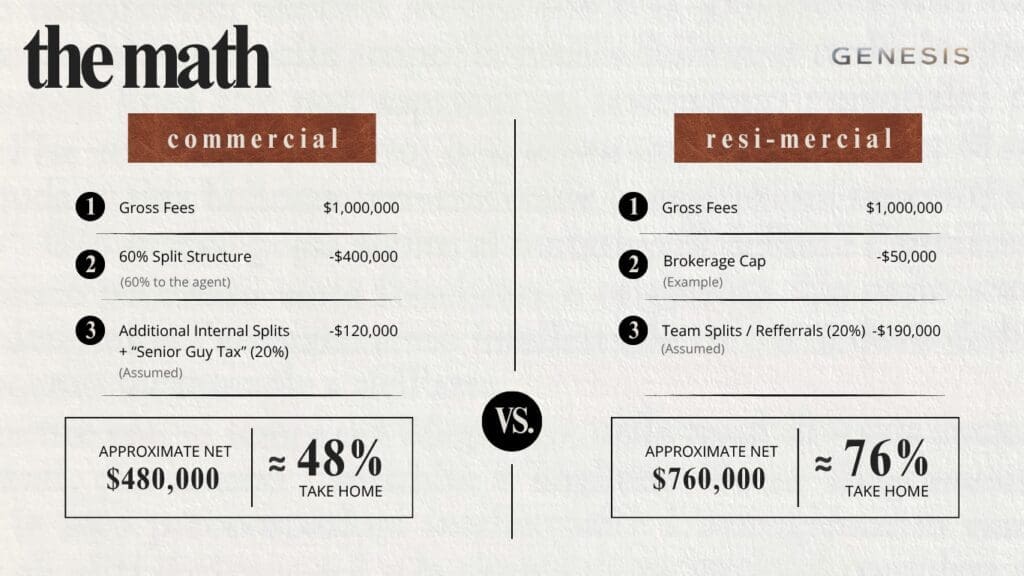
Let’s say two producers each generate $1M a year in gross fees. Yes, there are a lot of residential agents doing that, but I’m also using the number because it makes the math easy.
Commercial producer:
Typical base split structure with escalations (and some firms don’t even have escalation structures) maybe they average a 60% take-home after all the thresholds and production tiers.
$1,000,000 × .60 = $600,000
Now let’s factor in what I call the “senior guy tax.” Most commercial producers are splitting deals internally with senior brokers, partners, house accounts, corporate accounts, whatever you want to call it. I’ll be generous and say only 20% gets taxed away for one reason or another.
Now you’re at:
$480,000 net to the agent.
That’s a take-home of 48%… less than half.
But I also had years where, after all the splits, fees, and “senior taxes” came out, I personally took home less than 40% of what I had grossed.
Once you realize you’ve allowed yourself to think that’s normal, you start questioning your entire perception of the industry.
Now let’s look at the resi-mercial producer.
Working for a residential firm doesn’t automatically mean somebody doesn’t know how to do a commercial deal.
It may just mean they believe in math more than indoctrination.
A lot of residential firms run capped fee models. Something like 75/25 until the brokerage gets their first $50k. I know one firm that caps at $20k. I’ve personally never seen that model on the commercial side of the business.
So same $1,000,000 producer:
$1,000,000 – $50,000 = $950,000
Even if we assume that same agent gives away another 20% in team splits or referrals…
They’re still sitting around:
$760,000 or 76% take-home.
That’s $280,000 more income for the exact same production.
Run that math for the guy or gal grossing $500k a year. It’s the difference between spending 20 years on the brokerage hamster wheel versus having enough extra capital to start buying your own deals and getting off the wheel sooner.
Who’s laughing now?
The most money I had ever netted in my career, up until that point, was after I left the corporately affiliated commercial firm and temporarily hung my license at a residential company.
Truth.
I worked fewer deals, had almost no overhead, paid a closing coordinator when needed, and kept almost all of what I made. I spent more time with my wife and kids.
There were just fewer hands in my pocket extracting percentages of my earnings.
It was eye opening to say the least.
What surprised me was the realization that I was the one who felt foolish and also a bit unnecessarily arrogant.
I was taking home less while puffing my chest more.
Damn.
Those of us living on commissions are all playing the same game.
We are hoping other people sign contracts so we can feed our families.
The food on your table doesn’t know if it was paid for by a fee from a commercial deal or a residential one. Your belly doesn’t care either.
Fees earned are fees earned. Respect.
Think about it.
Landlines and flip phones fought for market share with each other while Steve Jobs created the iPhone.
He didn’t play the game he was supposed to. He changed it because he started seeing what people wanted, not what he was told he needed to sell them.
Jobs didn’t sell phones. He sold multi-purpose tools that could be utilized by the client for whatever need they had.
Seeing the real estate world from the other side for just a year made me ask a hard question:
Why are so many commercial agents conditioned to believe giving away half — or more — of their income is normal?
The answer is because most traditional commercial models were built in a different era.
A lot of those models now have to feed shareholders, partners, and layers of people consuming mailbox money while no longer participating in daily production.
And honestly, lack of change isn’t surprising when you realize very few people voluntarily give up mailbox money just to help a younger producer get out of the rat race faster than they did.
The model breeds more of itself.
It’s kind of like a flip phone feeling superior to a landline… while neither realizes the smartphone will eventually obsolete both of them.
When society is connecting refrigerators to WiFi, it’s probably time to recognize people like integrated experiences now.
It isn’t the 1990s anymore.
On the commercial side, a lot of firm structures still depend on convincing younger producers that they should hand over massive chunks of their income indefinitely because “that’s how you earn your stripes.”
Once I really recognized and did the math on what I was taking home after house splits, “senior guy tax,” and random corporate hands getting in my deal right before closing… the math just stopped mathing for me.
The game became incredibly obvious.
Now before my commercial peers come after me with tar and feathers… this isn’t me saying commercial expertise doesn’t matter. It absolutely does.
Commercial real estate requires experience and knowledge. Commercial is all I do.
Take a deep breath and count to ten.
My wife sells the houses and owns our sister company, www.vestarec.com.
But sometimes we act like commercial real estate is nuclear engineering and residential agents are somehow “less than.” That mindset is nonsense.

I think there are still plenty of commercial folks who, unfortunately, wish it still worked that way. But the times they are a-changin’.
So to the “resi-mercial” crowd:
If you’ve got a commercial deal, a client needing help, or something you want to learn about… call me.
I’d rather collaborate and make money together than show you my country club logo’d sweater vest.
Fees that hit your bank account spend exactly the same no matter what asset class they came from.
Do you like fees? I like fees.
Let’s go make more of those together.



Be the first to comment